Search for a baby book app and you will find polished timelines, milestone checklists, printed albums, shared family feeds and private journals. They all preserve memories, but they ask for very different kinds of effort. That matters. The best choice is not necessarily the app with the longest feature list; it is the one whose rhythm fits the way you already notice and save things.
Start with the kind of memory you naturally make
Think about the last meaningful moment you saved. Did you take a photo, type a sentence, record a video, send a voice note or keep a physical object? Your answer is a better starting point than a comparison chart.
Good when you already photograph often and want a visual timeline or printed album. Check how much captioning and layout work is expected.
Useful for longer stories, reflections and details a picture cannot explain. They work best if writing feels natural rather than like homework.
Helpful when several people want regular updates. Decide whether you are building a private keepsake, a communication channel or both.
Best for voices, laughter, songs and messages whose meaning lives partly in how they sound. Audio is less useful for visual milestones.
You do not have to force every memory into one format. A photo library can hold appearance, a physical box can keep hospital bracelets and cards, and an audio app can preserve a grandparent telling the story behind a name. A small system of two or three places is often more realistic than one “complete” archive.
Save the details your future self cannot recreate
Dates and measurements are easy to recognize as milestones, but ordinary context is often what disappears first. The weather on the walk home, the song you kept humming, the nickname that lasted three weeks and the exact sound of someone’s laugh can become surprisingly valuable later.
- The story around a milestone. Add who was there, what surprised you and what happened immediately before or after.
- Family voices. Invite a partner, sibling or grandparent to say something in their own words instead of writing on their behalf.
- Small routines. Record the bedtime song, the walk you took every afternoon or the phrase everyone kept repeating.
- Unfinished thoughts. A memory does not need a neat lesson. “I do not know how to describe today yet” is still an honest record.
- Context for photos. A single sentence about why an image mattered may outlast a folder of nearly identical pictures.
Be selective. Saving everything makes it harder to find what matters. A baby book should feel like a considered collection, not a second camera roll.
Use a five-minute routine instead of catching up
Many baby books are started with good intentions and abandoned when the backlog becomes intimidating. The easiest fix is to stop treating completeness as the goal.
- Choose one cue. Use the end of the week, a quiet Sunday or the first day of each month—not a daily streak.
- Pick one moment. Do not reconstruct everything. Choose the detail you would be disappointed to forget.
- Add one line of context. Say when it happened and why it stood out.
- Stop while it still feels easy. A short entry made now is better than an elaborate entry postponed forever.
If you miss several weeks, begin with today. Blank space is honest. It does not make the memories on either side less meaningful.
Audio is strongest when the voice is part of the memory
A written transcript can preserve the words “we cannot wait to meet you,” but it cannot preserve the pause before them, a familiar accent or the laugh at the end. That is where audio earns its place in a baby book.
Useful recordings can be very short: a thirty-second hello, the story of choosing a name, a song sung imperfectly, a sibling’s question, or an ordinary room full of familiar sound. Record close to the speaker in a quiet enough place, then give the clip a specific title. “Grandad explains the middle name” will be easier to find than “Recording 47.”
Audio does have limits. It cannot replace a photograph, medical record or written account when exact visual or factual detail matters. It also deserves care: ask before recording another person, especially in a private or emotional moment.
Five privacy questions worth asking first
Baby books can contain names, voices, dates, family relationships and personal stories. Before adding sensitive memories, look past the marketing language and answer five practical questions:
- Where are the memories stored—on the device, in the developer’s cloud or with another service?
- Is an account required, and what personal information does it request?
- Can you export or share individual memories in a useful format?
- What happens if you stop paying or the app is no longer available?
- Who can see a shared memory, and can you remove their access later?
No storage method removes every risk. Device-only storage gives you more direct control, but it also makes your own backup habits important. Cloud storage can make syncing easier, but requires trust in the service and its account security. Choose deliberately rather than assuming “private” means the same thing everywhere.
Where Bump Echo fits
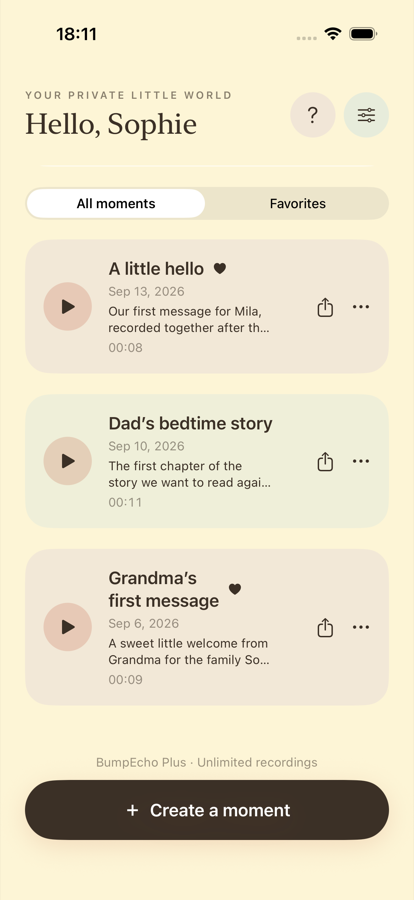
Bump Echo is built around one specific part of the baby-book idea: keeping voices and meaningful sounds. You can record messages, songs and everyday audio, title the moments and collect them in a private Soundbook on your iPhone. It is useful if audio is the piece missing from your photos and notes.
It is not a full photo-book designer, a family social network or a medical tool. It does not monitor a pregnancy or capture a fetal heartbeat. If you want printed layouts, automatic growth tracking or a shared stream for relatives, a different baby book app—or a second tool alongside Bump Echo—will be a better fit.

A private pregnancy Soundbook
Keep a memory in the voice that made it.
Bump Echo helps you record and organize messages, songs and everyday sounds on your iPhone. Use it for the moments whose meaning would be lost in a caption.
View Bump Echo on the App Store ↗A good baby book can stay small
You are not building an objective record of every day. You are leaving a few doors back into a period of family life. One photograph with context, one honest paragraph and one familiar voice may do that better than hundreds of entries completed out of obligation.
Choose a baby book app that makes the act of remembering feel lighter. Then save one thing this week. That is enough to begin.