A shared step challenge can turn an ordinary evening walk into a comeback, a friendly overtake or the reason someone messages the group. But a raw leaderboard can also become predictable: the most active person takes an early lead, everyone else quietly stops checking, and the challenge continues long after the interesting part is over.
The best step challenge app for your group is therefore not simply the one that counts the most things. It is the one whose rules and rhythm make sense for the people joining.
Start with the kind of challenge your group wants
Everyone starts together and the highest total wins. Easy to understand, but it favors people who already walk a great deal.
Compare each person with their own baseline. More inclusive, although it requires a trustworthy baseline period.
Combine several people’s steps. Social and forgiving, but team size and unusually high totals can affect balance.
The whole group works toward one number. Good for cooperation when competition would discourage someone.
Choose one scoring idea for each race. Apps that layer totals, streaks, multipliers, bonuses and manual awards onto the same leaderboard may offer more features while making the result harder to trust.
Duration matters too. Seven days includes weekdays and a weekend, gives positions time to change and ends before one difficult start becomes a month-long sentence. Longer challenges can work, but they benefit from stages or resets.
Understand where the steps come from
A step challenge app normally reads data recorded by a phone, smartwatch or health platform. That removes daily screenshots and manual spreadsheets, but it does not make every total identical. Devices may use different sensors and algorithms, people carry their phones differently, and syncing can happen at different times.
- Use one agreed source per person. Switching between phone and wearable totals during a race can create confusion or duplicates.
- Decide how late syncing works. A person should know whether steps recorded before the finish can arrive afterward.
- Be clear about manual entries. If the underlying health platform permits them, decide whether your friendly challenge accepts them.
- Treat totals as motivation, not laboratory measurements. A small difference between devices is normal.
- Check permissions. The app should explain what health data it requests and why.
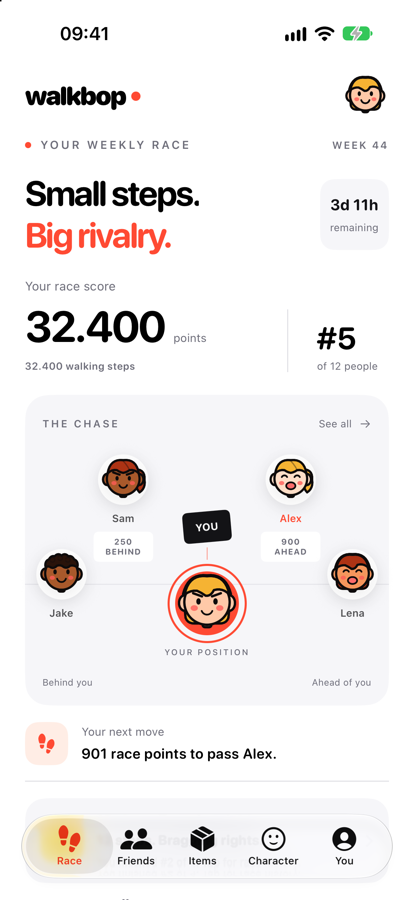
A good race screen should answer three questions quickly: Where am I? Who is close to me? What would change if I took another walk? A long analytics dashboard is not always more motivating than a clear gap to the next friend.
Look for more than first place
Only one person can lead, but a useful app creates more than one interesting moment. Passing a nearby friend, closing a gap, opening a mystery reward or starting fresh next week can keep the experience alive even when first place is out of reach.
Playfulness helps when it supports the walking rather than replaces it. Avatars, items and reactions can give the group something to talk about. They should not hide how the race is scored or pressure people into spending money to compete fairly.
Notifications deserve scrutiny too. Useful updates mark meaningful changes: someone passed you, the race is close, or the week is ending. Constant reminders can turn a friendly challenge into noise. Look for control over frequency and content.
A friend challenge still handles personal data
Step totals, display names, friend relationships and activity timing can reveal more than they first appear to. Before inviting the group, check what becomes visible and to whom.
- Does joining require a public profile, or can the race remain invitation-only?
- Are exact daily totals visible, or only the information needed for the current race?
- Does the app upload the full health history or only the step data it needs?
- Can a participant leave a race and remove their account or data?
- Do invitation links expire, and what happens if they are forwarded?
Minimum necessary sharing is a good principle. Friends need enough information to understand the challenge; they do not automatically need someone’s broader health record or precise location.
Fair does not always mean identical
Absolute step totals may not suit a group with different mobility, work patterns, health circumstances or access to safe walking spaces. Consider teams, personal-baseline challenges or a collective goal. Let people opt out without explaining private health information.
A step competition is not a fitness prescription. More is not always better, and pain, dizziness or other concerning symptoms are reasons to stop and seek appropriate advice. People with health concerns, mobility limitations or a major change in activity should use guidance appropriate to their circumstances.
The purpose of a friendly challenge is to support movement people can sustain. Punishments for missing a target, public shaming and permanent losing records tend to work against that.
How WalkBop fits
WalkBop is built around a simple format: a private weekly step race with friends. It uses Apple Health step totals, shows the people and gaps around you, and resets the story each week. Walking also earns mystery crates with playful items that can affect the shared race.
That makes WalkBop a fit for small groups who want a lively weekly competition rather than a corporate wellness dashboard or a detailed training plan. It is not a medical service, does not prescribe step targets and does not make different devices perfectly comparable. Apple Health access is optional, but real step totals are required for participating in a live race.

Weekly races with personality
Make the next walk part of the story.
WalkBop turns Apple Health steps into private weekly races with friends, live gaps, playful items and a fresh reset.
View WalkBop on the App Store ↗Try one week before building a tradition
Invite a small group, agree on the data source and finish time, then run one seven-day race. At the end, ask what people enjoyed and what felt unfair or confusing. Keep the useful parts, change one rule if needed and reset.
A successful challenge is not the one with the highest step total. It is the one people genuinely want to join again.
Sources and activity guidance
- CDC — About physical activity ↗
- U.S. Office of Disease Prevention and Health Promotion — Physical Activity Guidelines ↗