Give the week a recognizable rhythm
People are more likely to return when they understand what happens next. Use the same start and finish each week. Show current totals, positions and nearby gaps. Keep the scoring stable so walkers can make sense of the race without rereading rules.
- Day 1Start together from zero.
- Day 2Check that everyone is syncing.
- Day 3Notice the nearest gap.
- Day 4Share one encouraging update.
- Day 5Leave room for a comeback.
- Day 6Use the weekend naturally.
- Day 7Finish, recognize and reset.
Start with access, not pressure
Invite a group that actually knows one another and make joining simple. Explain what step source is used, when the race begins and what information other participants can see. Avoid setting a mandatory daily target unless everyone agrees it fits their circumstances.
If you are setting up the group for the first time, use the companion guide on starting a step challenge with friends.
Make midweek movement visible
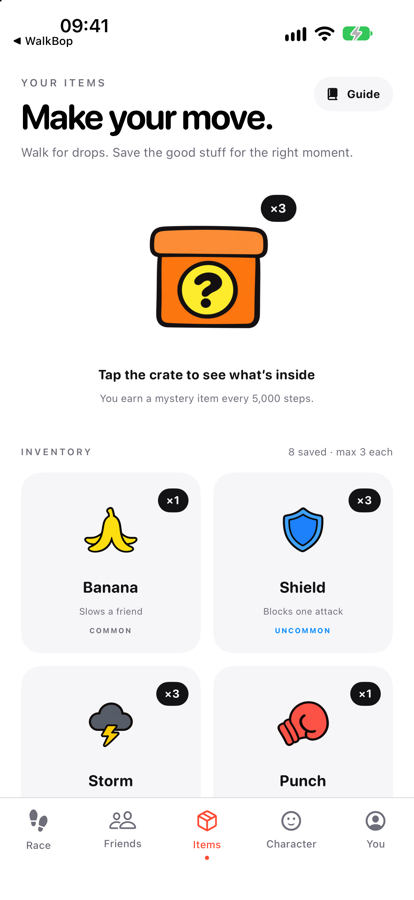
The middle of a challenge is where attention can disappear. Show changes that matter: who moved up, which gap narrowed and whether someone returned to the race. In WalkBop, walking also earns mystery crates, and items can create playful changes in the race. The steps remain real; the game gives people more moments to care about them.
Do not use public embarrassment or punishment to manufacture engagement. Friendly competition works when participants feel safe rejoining after a quiet day.
Leave room for different schedules
A weekly format includes both workdays and a weekend, which makes it more representative than a single-day sprint. Some people walk most during commutes; others have time on Saturday or Sunday. If schedules or abilities differ greatly, use teams, personal baselines or a shared group target.
Walking is generally accessible, but it is not identical for everyone. A social challenge should accommodate disability, pain, illness and medical guidance rather than treating one step total as a universal measure of effort.
Let the next week be genuinely new
Close the race at the promised time. Celebrate the winner and any memorable comeback, then clear the standings. A reset protects the challenge from becoming a permanent hierarchy. Someone who joined late or had a difficult week should have a credible reason to return.
Sources
- U.S. Department of Health and Human Services: Physical Activity Guidelines for Americans, 2nd edition.
- CDC: About physical activity.
This guide describes challenge design, not an individualized exercise prescription. Choose activity that is appropriate for your circumstances and professional advice.

A fresh story every week
Race, react and come back next Monday.
WalkBop turns Apple Health steps into weekly races with friends, visible gaps, mystery crates, playful items and racers that react to every twist.
View WalkBop on the App Store ↗