The practical difference is what happens before the split
Imagine two busy Friday shifts. At the first restaurant, every server and bartender adds all eligible tips to one shared amount. The restaurant distributes that pool according to hours or points. At the second restaurant, each server keeps most of their own tips but contributes a percentage to bussers, runners or bartenders. People may call the first arrangement a tip pool and the second tip sharing or a tip-out.
That distinction is useful for conversation, but it is not a universal legal dictionary. The U.S. Department of Labor uses “tip pool” broadly for arrangements in which tips are shared among employees, while workplaces and state rules may use tip pool, tip sharing and tip-out more narrowly.
| Question | Common pooled arrangement | Common sharing or tip-out arrangement |
|---|---|---|
| What goes in? | All or a defined category of tips | A portion of an employee's tips or sales |
| How is it divided? | Hours, points, role weights or equal shares | Percentage, fixed amount or category-based formula |
| What varies by shift? | The total pool and each person's allocation | Each worker's own tips, sales and required contribution |
| What should you verify? | Eligible workers, pool total and allocation rule | Calculation base, rate, recipients and final net tips |
The same $300 in tips can produce different outcomes
Suppose three workers finish a shift with $300 in eligible tips between them. These examples show the arithmetic only; they do not decide whether a particular workplace policy is lawful.
All $300 goes into a pool and three eligible workers receive equal shares. Each receives $100.
The same $300 is divided by eligible hours. Someone who worked half of the total eligible hours receives half of the pool.
A server with $200 in tips contributes 15%, or $30, to eligible support staff and keeps $170 before other adjustments.
A server contributes a percentage of sales rather than tips. The result can be higher or lower even when the displayed percentage looks smaller.
This is why “we share tips” is not enough information. A policy can change take-home earnings through the contribution base, the group of participants and the distribution method.
Ask five questions before comparing policies
- Which tips are included? Cash, card tips, tip jars and service charges may not all be handled in the same way.
- Who contributes? A policy might apply to servers only, the full front of house, or another defined group.
- Who receives a share? The answer should identify roles rather than relying on “everyone.” Eligibility can also depend on wage and tip-credit rules.
- What is the formula? Ask whether the calculation uses tips, total sales, category sales, hours, points or a fixed amount.
- When is the money distributed? Understand whether you receive the result after each shift, through payroll or on another documented schedule.
If you need help with the arithmetic, the tip pool calculator divides a pool by hours, while the tip split calculator divides by role or percentage. Calculators explain numbers; they do not validate a policy.
Federal rules set guardrails, and state law may go further
Under the U.S. Fair Labor Standards Act, employers, managers and supervisors generally may not keep employees' tips or receive distributions from a tip pool. The Department of Labor also distinguishes between traditional pools used when an employer takes a tip credit and nontraditional pools that may include certain non-tipped workers when the employer pays the full federal minimum wage directly.
State and local law may be more protective than federal law. Job titles alone do not always settle whether someone is treated as a manager or supervisor, and a mandatory service charge is not automatically treated as a tip under federal rules. For a real workplace dispute, use current official guidance or qualified legal advice rather than a blog summary.
Important: this article explains common terminology and federal basics for education. It is not legal, payroll, tax or financial advice, and it cannot determine whether your workplace policy is lawful.
Keep a record that lets you reconstruct the shift
A worker usually cannot control the workplace formula, but they can keep a clear personal record. Write down gross tips, cash tips, card tips, tip-out or pool contribution, hours worked and the final amount received. If the policy uses sales, record the relevant sales base too.
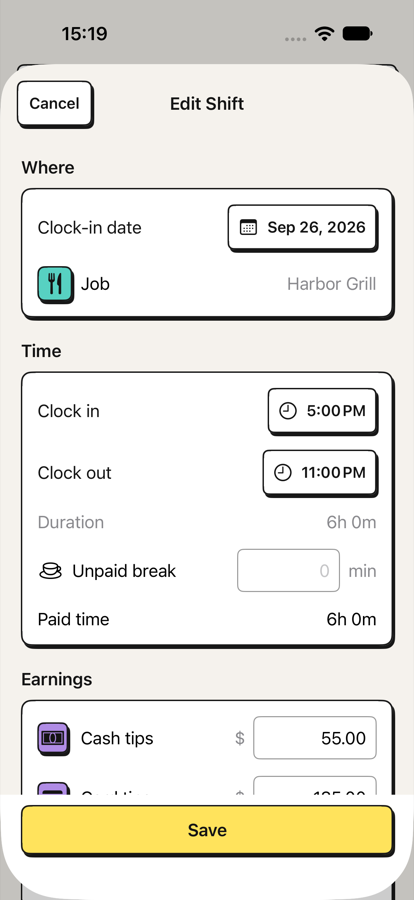
Look for patterns across several shifts: effective hourly earnings, changing tip-out amounts and differences between busy and quiet days. A single shift can be unusual. A consistent record is more useful when checking a pay statement or asking a specific question.
Official sources
- U.S. Department of Labor — Fact Sheet #15: Tipped employees under the FLSA ↗
- U.S. Department of Labor — Fact Sheet #15B: Managers, supervisors and tips ↗
- U.S. Department of Labor — State labor office contacts ↗
Editorial note: terminology varies across workplaces and jurisdictions. We checked the legal guardrails against current U.S. Department of Labor guidance on November 16, 2026.

A private tip and shift tracker
Remember what each shift actually paid.
TipHaven keeps your tips, tip-out, hours and direct wages together, then shows the resulting net tips and hourly earnings.
View TipHaven on the App Store ↗