When broadleaf trees lose their leaves, the identification clues do not disappear. Buds formed during the growing season remain on the newest twigs through winter. Their arrangement, shape and protective scales—together with leaf scars, lenticels, bark and persistent fruit—can narrow an unknown tree surprisingly well.
The trick is to resist jumping from one attractive bud to a species name. Winter identification works like a short chain of evidence. Begin with the branching pattern, move closer to the bud and twig, then step back again to check the whole tree and its location.
First question: opposite or alternate?
Look along a healthy recent twig. Do buds appear in pairs directly across from each other, or does each bud sit alone and alternate from side to side? This first split can remove many impossible candidates before you worry about fine detail.
Buds and leaf scars occur in pairs at the same point on the twig. Check several nodes because damage can remove one side of a pair.
One bud occurs at each node, often creating a staggered or spiral pattern along the twig.
Three or more buds share a node. This is less common and can become a strong clue when clearly present.
Several buds may crowd the end of a twig without being truly whorled. Photograph the spacing rather than relying on memory.
Follow the twig back far enough to see more than one node. A single close-up can hide the arrangement entirely, and a broken or browsed tip may imitate a natural branching pattern.
Then read the bud itself
Terminal buds occur at the end of a twig; lateral or axillary buds occur along its sides. Some trees lack a true terminal bud, so the last side bud may appear to sit at the tip after the twig ends. That difference is easier to see when the leaf scar and a small twig-end scar are both visible.
For each bud, notice:
- Shape. Is it narrow and pointed, blunt, rounded, egg-shaped or flattened against the twig?
- Scale pattern. Are there many overlapping scales, two meeting scales, a single visible scale or no obvious scales?
- Surface. Is it glossy, dull, sticky, hairy or powdery?
- Color. Record it, but treat color cautiously because light, age and weather can change how it appears.
- Position. Does the bud sit close against the twig, project outward or rest on a small stalk?
- Relative size. Compare terminal and lateral buds on the same twig rather than estimating from a photo without scale.
Flower and leaf buds can differ on the same plant. A rounder bud may hold flowers while a narrower one holds leaves, but this is not a universal rule. Use a species-specific reference before labeling the contents.
The marks below the bud are part of the clue
After a leaf falls, it leaves a scar on the twig. Shape, size and the small vascular bundle marks inside that scar can be distinctive. A hand lens or close, sharply focused photo helps. Also look for stipule scars, which may form lines around part or all of the twig in some groups.
Recent twig growth is usually more useful than an older branch because older surfaces lose detail. Record the twig’s color and thickness, whether it is smooth or hairy, and the pattern of lenticels—the small pores visible as dots, dashes or raised marks. Thorns, corky ridges, odor and pith can also matter, but do not cut or scratch a tree unless you have permission and it is appropriate to do so.
Take four photographs, not one extreme close-up
- The whole tree. Include overall form, branching and surrounding habitat.
- A complete recent twig. Show several nodes, the tip and enough length to reveal arrangement.
- The bud and leaf scar together. Hold the camera parallel to the twig and tap the bud to focus.
- Supporting evidence. Photograph bark, persistent fruit, seeds, thorns or another distinctive feature.
Add something for scale without covering the feature. A small ruler is better than a finger because finger size varies and phones can make nearby objects look larger. Use diffuse daylight when possible; flash can erase surface texture or make every bud look glossy.
If the tree is tall, do not break a branch just to get a closer photograph. Search for naturally fallen fresh twigs beneath the same crown, use binoculars or record the clue as unknown. Make sure a fallen twig truly belongs to the tree above before relying on it.
A bud suggests a candidate; agreement confirms it
Photo-identification tools can offer a useful shortlist, but buds from related species may look similar and a model may receive too little geographic or seasonal context. Check the candidate against a regional key that describes the species in your area.
- Does the opposite or alternate arrangement agree?
- Do bud scales, shape and twig features match the key?
- Is the tree known from this region and habitat?
- Do bark, persistent fruit and overall form support the same answer?
- Can you return after leaves or flowers emerge for another independent check?
Keep uncertainty visible. “Likely field maple” is a better record than a confident species name based on one blurred bud. Identification quality improves when future evidence can correct the earlier guess.
How Oqvi fits the field process
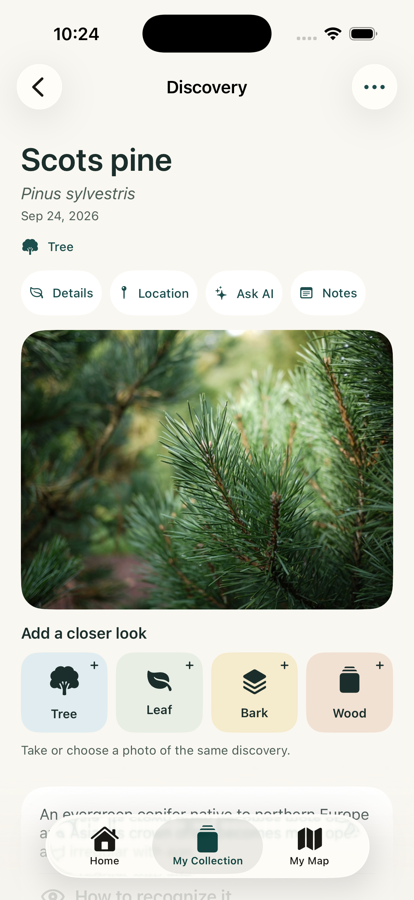
Oqvi can analyze photos of trees, leaves, flowers, bark and wood and suggest an identification. You can keep multiple images, notes and an optional place with the discovery in a private collection on your iPhone. For winter work, that makes it useful as a field notebook: save the twig now, then add or compare new evidence when the tree changes season.
Oqvi does not certify a species and should not be used to decide edibility, toxicity, treatment, structural safety or whether wood is suitable for a particular purpose. When the answer affects health, property or conservation work, use an appropriate regional authority or qualified expert.
A private botanical field collection
Notice the bud. Keep the whole discovery.
Oqvi helps you identify and record trees, plants, flowers, bark and wood, with photos and notes kept together on your iPhone.
View Oqvi on the App Store ↗Editorial note: This guide provides educational field-identification information. It was reviewed against university extension and forestry references. Regional keys remain essential because species and useful distinguishing features vary by location.
Sources and further reading
- University of Wisconsin–Madison Extension — Tree identification ↗
- University of Florida IFAS Extension — How to identify a tree ↗
- Texas A&M Forest Service — How to identify trees ↗