Social platforms are excellent at showing you food at the exact moment it looks irresistible. They are less helpful on a Wednesday evening when you remember “that tomato pasta,” cannot recall who posted it and have no idea whether you own the ingredients.
A social media recipe saver closes that gap. It should not merely create another folder of links. It should turn an appealing post into a recipe you can understand, adjust and use without replaying a thirty-second video with flour on your hands.
Why a saved-post folder stops being useful
The problem is rarely a lack of inspiration. It is that social saves are organized for returning to content, not for making a meal. A creator may place quantities in the caption, technique in the video, substitutions in a pinned comment and cooking time nowhere at all. If the post is removed, made private or buried among hundreds of saves, the idea becomes difficult to use.
“Easy dinner” sounds good in a feed but tells you very little when searching your own collection.
Ingredients, timing and technique may be split between audio, captions, on-screen text and comments.
You may forget whether you saved it for a quick lunch, a dinner party or one particular ingredient.
A recipe can remain inspiring for months without ever meeting a grocery list or an available evening.
The goal is not to copy every piece of social content into a private database. It is to give the genuinely useful recipes enough structure to survive outside the feed.
Use a four-step save, review, plan, cook workflow
- Save the public source. Share or copy the recipe link into the recipe saver while the post is still easy to find.
- Review the recipe draft. Confirm the title, ingredients, quantities, serving size and method against the original.
- Give it a reason to return. Add a useful note or place it in a short “cook next” list instead of filing it into a huge archive.
- Update it after cooking. Record what you changed, what worked and whether it deserves another round.
That last step is what turns someone else’s post into your recipe. A note such as “use half the chilli,” “worked well in the small pan” or “make double next time” is often more useful than another category or tag.
Treat every automatic import as a draft
Recipe importers can save time, but a social video is not a standardized recipe card. On-screen text may disappear quickly. A caption may omit an ingredient shown in the video. Automatic transcription can confuse similar words or numbers. Creators also make ordinary mistakes.
- Check quantities and units. A missing zero or a confused tablespoon can change the result completely.
- Match every ingredient to a step. If an ingredient never appears in the method—or a step introduces something absent from the list—investigate.
- Confirm serving size. “Serves four” means little if the source used a different pan, portion or side dish.
- Rewrite ambiguous instructions. Replace “cook until done” with the visual cue, time or safe internal temperature you will actually use.
- Review allergens yourself. An import cannot guarantee that a recipe or branded ingredient is safe for a particular allergy.
For meat, eggs and other safety-sensitive foods, use current guidance from an authoritative food-safety source. A social post, imported draft or AI-assisted recipe should not be your only source for safe handling and doneness.
Organize recipes by intention, not by platform
Separate Instagram and TikTok folders may feel tidy, but the platform rarely matters when deciding what to eat. Organize around the question you will ask later: What can I cook quickly? What uses the vegetables I have? What works for guests? What do I want to try this week?
A small active list is more useful than an elaborate taxonomy. Keep a broad searchable cookbook for the long term and a short “cook next” list for the near future. If that list grows beyond what you could realistically make in a few weeks, remove something. Prioritizing is part of recipe organization.
Use specific titles too. “Creamy tomato pasta with basil” will be easier to find than “viral pasta,” especially after the trend is no longer viral.
The real test happens away from the feed
A good social media recipe saver should reduce the number of times you return to the original platform. You may still watch the source to understand a technique or credit the creator, but ordinary cooking should not depend on pausing, rewinding and dismissing notifications.
Before choosing a recipe saver, ask whether it supports the steps after capture:
- Can you edit ingredients and instructions?
- Can you scale or adjust servings without losing the original amounts?
- Can ingredients move into a grocery list?
- Can you mark what is already in the kitchen?
- Is there a readable cooking view for following one step at a time?
- Can you keep your own notes after making the dish?
If the answer is no, you may simply be moving links from one folder to another.
How Fovri fits this workflow
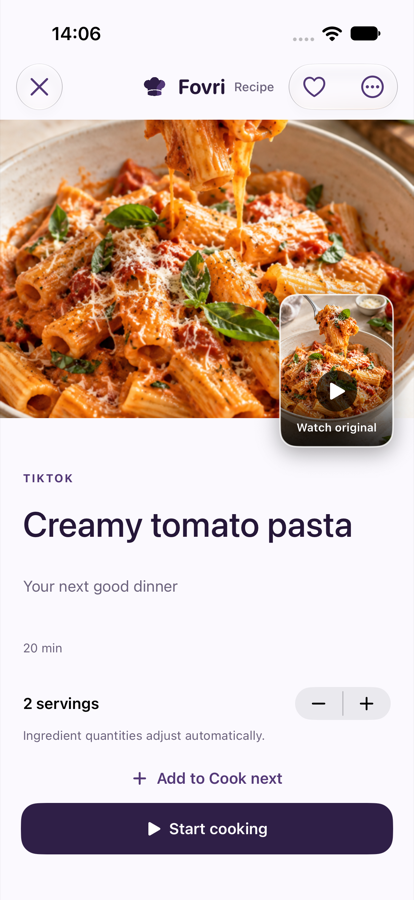
Fovri is designed to take supported public recipe links from places such as Instagram and TikTok and turn them into editable recipes on iPhone. The original source remains attached for reference and creator context. You can then review the draft, change the serving count, add it to Cook next, move ingredients to groceries and follow the recipe in a cooking view.
Fovri is not a social-network downloader and it cannot import private, removed or restricted posts. It does not guarantee that automatically gathered ingredients, nutrition, allergens or instructions are correct. The person cooking remains responsible for reviewing the source and recipe.

From saved idea to dinner
Give the recipe a life beyond the feed.
Fovri turns supported public social recipe links into editable recipes, then connects them to Cook next, groceries and guided cooking on iPhone.
View Fovri on the App Store ↗Save less, cook more
You do not need to rescue every recipe from your feed. Start with three you genuinely want to make. Review them while the source is still fresh, choose one for this week and add only its missing ingredients to your grocery list.
A useful recipe collection is not measured by how many links it holds. It is measured by how often it helps you answer the ordinary question: what can I make tonight?