Cutting down is not risk-free smoking. Smoking fewer cigarettes is less helpful than quitting completely, and inhaling more deeply or smoking more of each cigarette can reduce the expected benefit. This guide is general information, not a personalized treatment plan.
Use reduction as a bridge, not proof that smoking is safe
There are good reasons someone may not be ready to stop all at once. A gradual plan can feel less abrupt, reveal which cigarettes are automatic and create practice for a future quit attempt. The National Cancer Institute notes that people who cut back may be more likely to stop in the future, while also emphasizing that smoking less is not as helpful as quitting altogether.
That distinction matters. Cigarette count is easy to measure, but it does not measure smoke exposure precisely. Some people compensate for fewer cigarettes by taking deeper puffs, smoking farther down or changing how they inhale. Treat the count as a planning tool—not a medical score and not permission to label a reduced level “safe.”
Begin with three ordinary days
Before choosing a lower target, record what is happening now. Include at least one workday and, if your routine differs, one weekend day. Log each cigarette when it happens rather than reconstructing the day at night.
Notice clusters and the distance between cigarettes, not only the daily total.
Coffee, commute, break, meal, alcohol, social time or a quiet moment alone.
Craving, routine, stress, boredom, concentration, reward or being offered one.
Which cigarettes feel hardest to imagine changing, and which barely register?
The baseline is not a test to pass. Under-recording produces a plan for a day you do not actually live. If you smoke more than expected, that is useful information about timing and triggers.
Remove planned cigarettes, not random ones
Choose a first step that is specific enough to follow for several days. “Smoke less” requires a fresh decision every time. “Wait until after breakfast for the first cigarette” or “skip the cigarette during the short afternoon break” tells you what to do when the moment arrives.
- Choose one predictable cigarette. Start with a routine cigarette that feels less important, not necessarily the first or strongest craving of the day.
- Change the cue. Move coffee to another room, take a different route, or spend the break with someone who does not smoke.
- Increase friction. Keep cigarettes out of immediate reach, carry only the planned amount or avoid buying extra packs “just in case.”
- Delay before removing. Add ten or fifteen minutes to a predictable cigarette. Use the delay to observe whether the urge rises, changes or passes.
- Hold the level briefly. Learn what the new pattern feels like before making another reduction.
A planned reduction should still be flexible enough for real life. If a target repeatedly produces intense withdrawal or feels unmanageable, that is a reason to seek support—not evidence of weak motivation.
Plan for the moment after “not this cigarette”
Removing a cigarette leaves a gap in both nicotine intake and routine. Prepare a response before the trigger arrives. Different moments may need different tools.
- Delay. Decide to wait a few minutes, then reassess instead of arguing with the entire future.
- Change location. Leave the place where you usually smoke, even briefly.
- Use slow breathing. A short breathing exercise can create a pause, although it does not treat nicotine dependence.
- Occupy hands and mouth. Water, sugar-free gum or a simple task may help with the routine component.
- Contact support. Tell someone what moment is difficult instead of waiting until the plan has already slipped.
Withdrawal can include irritability, restlessness, difficulty concentrating, sleep changes and strong cravings. You do not have to manage it with willpower alone. Evidence-based cessation medication and counseling can reduce withdrawal and improve the chances of quitting.
Professional support belongs in a gradual plan too
You do not need to wait until a quit day to speak with a healthcare professional or quitline. They can help you assess nicotine dependence, discuss counseling and decide whether a cessation medication is appropriate for you.
The CDC states that counseling and medication are each effective and that using them together can more than double the chances of quitting. Options for adults who smoke cigarettes include nicotine-replacement products and prescription medicines, but suitability and instructions vary. If you are pregnant, breastfeeding, under 18, use other tobacco or nicotine products, have relevant health conditions or take other medicines, seek individualized professional advice before using cessation medication.
In the United States, 1-800-QUIT-NOW connects callers with free, confidential state quitline support. Outside the US, use your national stop-smoking service or ask a healthcare professional or pharmacist about local help.
A difficult day is data, not a cancelled plan
If you exceed the target, record what happened without changing the count. Was it a stronger withdrawal day, an unexpected social situation, alcohol, stress, poor sleep or a target that moved too quickly? The answer helps you choose the next adjustment.
Resume with the next cigarette or the next day. Avoid trying to “make up” for it with an extreme restriction that was not part of the plan. Tobacco dependence is a relapsing condition, and many people need repeated attempts and different combinations of support before quitting. Repetition is part of the process, not proof that change is impossible.
How Calmber fits—and where it does not
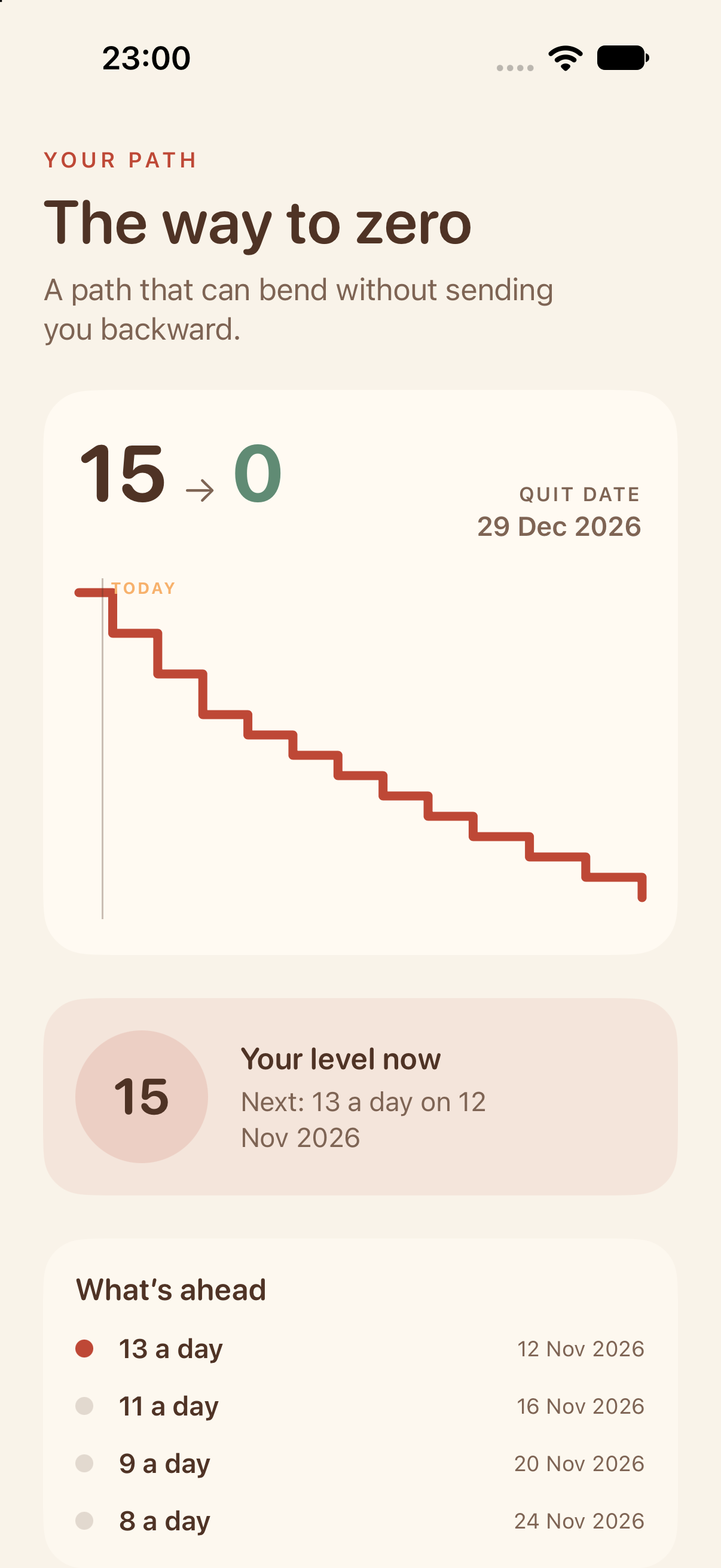
Calmber is a private iPhone companion for adults who want to reduce or quit smoking. It lets you log cigarettes, review timing and money patterns, choose an adjustable taper pace, follow daily limits toward a quit day and use short craving tools such as breathing, delaying and urge surfing.
Calmber does not diagnose nicotine dependence, recommend or monitor medication, assess symptoms, replace counseling or provide emergency help. Its role is to make the behavior and chosen plan easier to see. Medical decisions stay with you and an appropriate healthcare professional.

A calmer path toward zero
Track honestly. Adjust deliberately.
Calmber keeps cigarette logs, an adjustable taper plan, timing patterns and short craving tools together on your iPhone.
View Calmber on the App Store ↗Editorial note: Reviewed against current public information from the CDC, National Cancer Institute and Smokefree.gov on November 16, 2026. This guide supports informed planning but does not provide individualized medical advice.
Sources and support
- National Cancer Institute — Smoking risks, reduction and quitting ↗
- CDC — Evidence-based treatment for tobacco dependence ↗
- Smokefree.gov — Build a quit plan ↗
- CDC — Quitlines and cessation support ↗