Start with the useful minimum
When head pain is active, a long questionnaire is the last thing many people want. A good headache tracker app should let you save the minimum first and add context later. The minimum is usually the date, approximate timing, severity or functional impact, and whether medication was taken.
The American Migraine Foundation recommends recording headache frequency along with location, intensity, quality and associated symptoms such as nausea or sensitivity to light and sound. Medication timing and response can also matter. That does not mean every field must be completed during every episode.
| Record first | Add when useful | Leave blank when unknown |
|---|---|---|
| Date and approximate start | Pain location or quality | An exact start minute you did not observe |
| Severity or effect on activity | Associated symptoms | A “trigger” you are only guessing about |
| Medication name and time | Relief and side effects | Details you cannot reliably recall |
| End time or duration | Sleep, meals, stress or menstrual context | A diagnosis the app cannot make |
A blank is useful information. It means “not recorded,” not “did not happen.” Apps that silently convert missing answers into symptom-free days can make the history look cleaner than it really is.
Avoid a tracker that turns correlation into certainty
If headaches often follow poor sleep, that pattern may be worth discussing. It does not prove that sleep was the cause. The same is true for food, weather, caffeine, hormones or stress. A tracker should show timing and repetition without declaring a trigger or recommending treatment.
Neutral language helps. “Coffee at 09:00; symptoms around 11:30” preserves what you observed. “Coffee caused the headache” adds a conclusion the record alone cannot establish. Our migraine symptom tracking guide gives more examples of observation-first wording.
Use a three-part workflow
- Capture the episode. Save a short entry while the information is fresh. Approximate timing is better than false precision.
- Complete it later. Add duration, symptoms, medication response and impact when you have the attention to do so.
- Review the month. Look at headache days, medication days and gaps in the record before trying to interpret individual details.
This workflow separates recording from analysis. It also reduces the temptation to fill every field simply because the app presents one.
The report is where the app earns its place
A list of individual episodes can become difficult to scan. Before an appointment, the useful questions are often broader: How many headache days were recorded? How severe were they? Which medications were used, and how often? What changed in function or frequency?
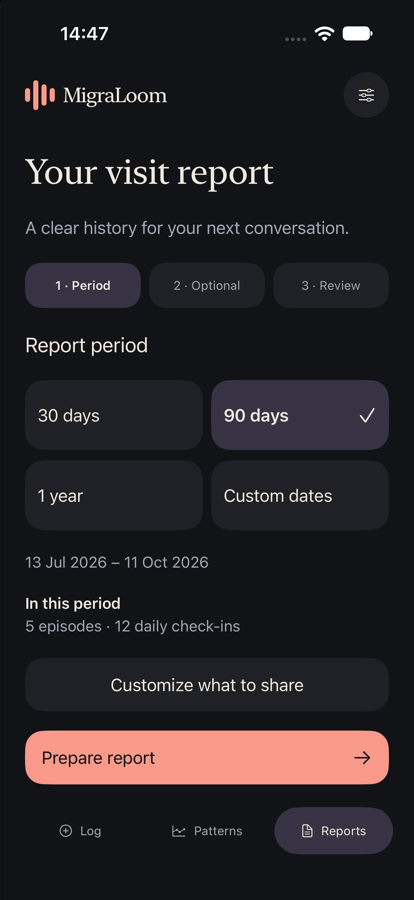
Check whether a tracker can export or present a readable summary without requiring the clinician to learn the app. A report should retain dates and uncertainty, not hide them behind a single “health score.”
Check privacy, access and pricing before committing
Headache records can include sensitive health information. Look for a clear explanation of where data is stored, whether an account is required, how exports work and what happens if you stop paying. A free download does not necessarily mean every useful feature remains free.
Can you understand where the record lives and whether it leaves your device?
Can you retrieve or export the history when you need it?
Is the ongoing cost, trial or lifetime option explained before you invest time?
Can you record the essential details on a difficult day?
MigraLoom keeps its diary on your iPhone and requires no account. Access is offered through the options shown in the app, including a one-time lifetime purchase where available. Review the current App Store listing and in-app purchase screen for the price in your region.
A tracker supports care; it does not replace it
Headache and migraine symptoms vary, and a record cannot determine a diagnosis. The NHS notes that keeping a migraine diary may help identify possible patterns, but new, severe or changing symptoms still need appropriate medical assessment.
Bring the record to a qualified healthcare professional rather than changing prescribed treatment based only on an app pattern. If tracking increases anxiety or becomes burdensome, simplify the fields or discuss another approach with your clinician.
Sources
- American Migraine Foundation — Headache journals: tracking your migraine ↗
- American Migraine Foundation — Migraine symptoms FAQ ↗
- NHS — Migraine ↗
- NHS — Headaches and emergency signs ↗
Editorial note: This guide provides general information, not medical advice. It was checked against the sources above on November 16, 2026.

A calm, private migraine diary
Record what happened without forcing an explanation.
MigraLoom keeps episodes, patterns and appointment reports together on your iPhone, with no account required.
View MigraLoom on the App Store ↗